Car Pulling to One Side? Here's How to Fix Tyre Alignment
Have you ever felt that your car is pulling to one side while driving? If yes, then you should know that it’s not normal and is not something you ignore, as this is one sign that your car needs tyre alignment. We will discuss more signs later in this blog.
Additionally, you will also get to know how wheel alignment is done and whether you can do it at home or not.
At Morley Tyre Centre, we offer the best tyre alignment services, so you can schedule your appointment today.
Let’s have a look at signs first:
Signs Your Car Needs a Wheel Alignment
We divided the signs into two broad categories: one is driving-related, while the other is tyre-related. You’ll notice at least one of them if something’s wrong with your car tyres.
Driving-Related Signs
First of all, when you’re going straight, and you notice that your steering wheel is slightly tilted, that’s a clear sign something’s off.
Secondly, your car starts pulling to one side while driving, as it will slowly drift left or right. You correct it, but it happens again and again. Know that there must be an alignment issue.
Moreover, you will feel that the steering is loose or shaky, especially at higher speeds. It also indicates that there is a problem in car’s alignment.
Tyre-Related Signs
Now let’s talk about tyres. If one side of the tyre is more worn than the other, that’s uneven wear, and it might be caused by bad alignment. Moreover, if one tyre wears out faster than the rest, that’s another red flag. And in some cases, tyres look slightly angled when you stand in front of the car. That’s also not normal.
Remember, if you ignore these signs, you’ll end up replacing tyres way sooner than your expected time. Moreover, if you can’t observe any sign, our experts advise that you must get a wheel alignment after every 10,000 km or every 9 to 12 months.
Now is the time to have a look at how wheel alignment is done:
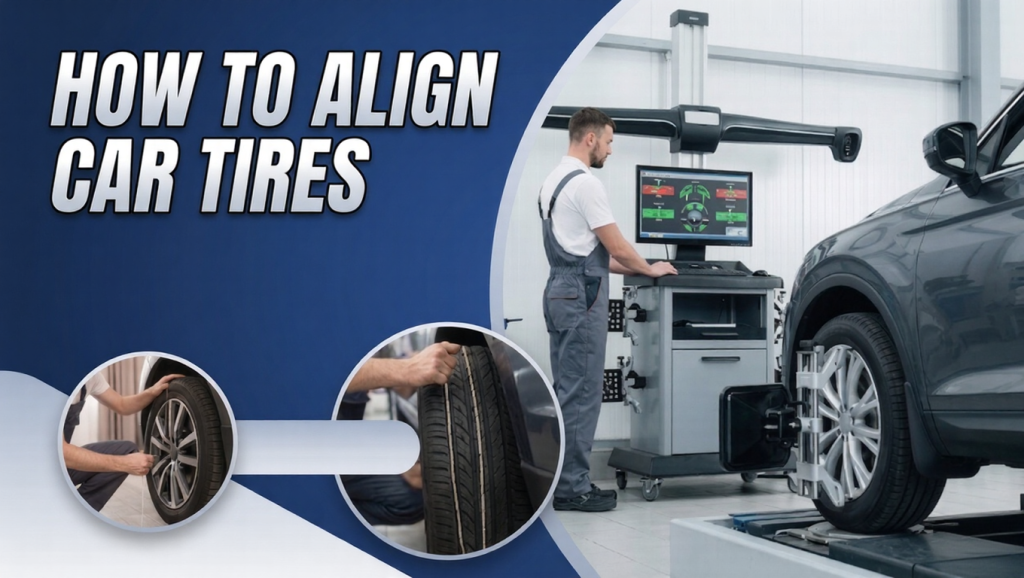
How to Align Car Tires
Below, we have shared how professional tyre alignment is done in four steps. Have a look:
Step 1 – Inspection of Tyres and Suspension Parts
Before anything, your tyres and suspension will be checked, and if parts like tie rods or bushings are worn out, these issues will be fixed. We will also keep an eye on the tyre pressure because uneven pressure can mess with alignment readings.
Step 2 – Measurement of Alignment Angles
There are three main angles involved: toe, camber and caster. The toe is the most important one; it’s about whether your tyres point slightly inward or outward. Camber is the tilt of the tyre, like whether your tyres are leaning in or out, that’s camber. Caster affects steering stability. Our special machines will measure all of these with high accuracy. It is important to mention that this measurement is difficult to do properly at home.
Step 3 – Adjustment of toe angle
If your tyres are pointing too much inward or outward, small adjustments will be made using designated tools. This step is most important, and even tiny changes here will make a big difference in how your car drives.
Step 4 – Rechecking of alignment and test drive
Once the above adjustments are done, everything will be checked again, and our experts will do a test drive. They make sure that when the steering is centred, the car is moving in a straight direction, and there is no pulling or any weird feeling of the car getting out of direction.
How to Check Tyre Alignment at Home
These three checks give you a basic idea of whether your car needs alignment. They do not replace a professional assessment but help you catch early signs before damage worsens.
Straight Road Driving Test
Find a flat, straight road with no traffic. Drive at a steady speed and gently loosen your grip on the steering wheel. If your car drifts left or right without turning, that is a clear alignment warning sign. Perth drivers often notice this on long straight stretches like Reid Highway or Tonkin Highway where crosswinds are minimal.
Visual Tyre Inspection
Park your car and crouch down to tyre level. Compare the inner and outer edges of each tyre. If one edge is noticeably more worn than the other, your wheels are likely misaligned. Check all four tyres, not just the front ones, as rear misalignment is common in AWDs and 4WDs.
String Method
Run a piece of string along both sides of your car parallel to the ground, close to the tyres. The gap between the string and each tyre should be equal front and back. If one side is closer or further, your wheels are out of alignment. This method works best on a flat garage floor.
These checks help you identify the problem early. However, home checks only tell you something is wrong, not how far out your alignment is or which angles need adjusting. That requires specialist equipment.
If any of these checks raise a concern, book a professional wheel alignment in Morley before the issue affects your tyres further. Book online today or call (08) 9276 3488.
Also Read: Regular Tyre Maintenance | How to Maximise Tyre Lifespan?
Wheel Alignment Cost Australia: What Perth Drivers Actually Pay
Front wheel alignment in Australia costs $50 to $75 for most standard vehicles, while a full four-wheel alignment runs $100 to $150 in 2026. SUVs and 4WDs typically cost more, ranging from $100 to $180 depending on suspension complexity.
At Morley Tyre Centre, we provide upfront quotes before any work begins. No hidden costs. Luxury vehicles, AWDs, and modified cars typically cost more due to additional adjustment points.
Regular alignment also saves money long-term. Misaligned tyres wear unevenly and need replacing sooner, which costs far more than a routine alignment check.
For a full breakdown of what affects pricing in Perth, visit our Wheel Alignment Cost Guide.
Wheel Alignment vs Wheel Balancing
Wheel alignment fixes the angles of your tyres, so if your car pulls to one side or tyres wear unevenly, wheel alignment will fix this problem. In contrast, wheel balancing is all about weight, so if your steering wheel vibrates, especially at higher speeds, your wheels are probably unbalanced, and wheel balancing will fix this issue. So in a nutshell, we can say that alignment affects control, and balancing affects comfort.
Get Your Car Tires Aligned at Morley Tyre and Auto Centre
A good wheel alignment service always keeps your car safe and efficient, so don’t ignore the signs and do regular checkups.
Morley Tyre and Auto Centre is one of the best for tyre alignment because we’ve been serving Perth drivers for over a decade now, so schedule now and drive your car with confidence.