Check Engine Light On? Here's What It Means & What to Do
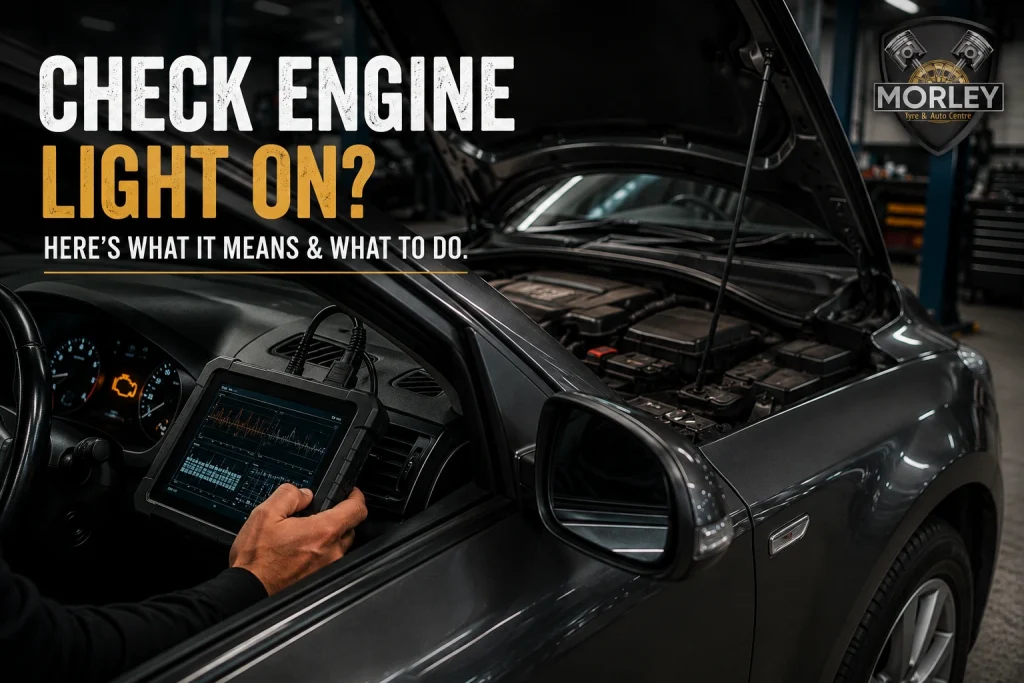
If that little orange engine symbol just lit up on your dash, you’re probably wondering the same thing every Perth driver wonders: can I keep driving, or do I need to pull over right now? The honest answer depends on how the light is behaving, not just the fact that it’s on.
The check engine light is your car’s onboard computer telling you it’s found something outside normal range anywhere from a loose fuel cap to a serious misfire. It’s not a diagnosis on its own. It’s a prompt to get the fault codes read before a small problem turns into an expensive one.
Here’s how to understand it properly, what usually causes it, and what a diagnostic in Perth is likely to cost you straight from the workshop floor at Morley Tyre & Auto Centre.
Check Engine Light Flashing vs Solid: What’s the Difference?
This is the first thing to check, because it changes what you should do next.
A solid, steady light means the engine control unit has logged a fault, but it isn’t urgent enough to shut things down. The car will generally still drive normally. You shouldn’t ignore it, but you don’t need to panic either get it scanned within the next week or two.
A flashing light is a different story. This almost always points to an active misfire, where unburnt fuel is being dumped into the exhaust. Left alone, that raw fuel can overheat and destroy your catalytic converter within minutes of driving turning a $300 spark plug job into a $1,500+ repair.
If it’s flashing, find a safe spot, pull over, switch the engine off, and arrange a tow rather than trying to nurse it home.
|
Light behaviour |
What’s likely going on |
How urgent |
What to do |
|
Steady / solid |
Sensor fault, loose cap, minor emissions issue |
Low to moderate |
Book a scan within 1–2 weeks |
|
Flashing |
Active engine misfire |
Critical |
Stop, switch off, call for a tow |
|
On + other warning lights or symptoms |
Could involve cooling, oil pressure, or drivetrain |
High |
Pull over and get roadside help |
5 Causes for the Check Engine Light to Come On?
Five faults account for most check engine light triggers in everyday cars around Perth:
- Loose or damaged fuel cap: This is genuinely the most common one. A cap that isn’t clicked shut properly lets fuel vapour escape and drops pressure in the evaporative emissions system. Give it a firm turn until it clicks and the light often clears itself within a few drive cycles.
- Failing oxygen sensor: This sensor reads how much unburnt oxygen is in your exhaust so the engine can balance the fuel mix. Once it starts giving bad readings, fuel economy drops and, if left long enough, it can damage the catalytic converter.
- Worn spark plugs or ignition coils: These are behind most misfires, which is exactly why they’re linked to a flashing light rather than a steady one.
- Dirty or faulty mass airflow (MAF) sensor: This one throws off the fuel-to-air ratio and often shows up as rough idling or hesitation on acceleration.
- Catalytic converter problems: Usually the end result of an earlier issue (misfire, bad O2 sensor) that went unfixed. It’s also the most expensive fault on this list to put right.
Perth’s climate plays a small part too; hot conditions and heat-stressed vacuum or EVAP hoses can crack over time and trigger similar codes, so it’s not always the sensor itself that needs replacing.
Can I Still Drive with the Check Engine Light On?
If the light is solid and the car feels and sounds the way it always does, you can usually drive it to a workshop. Just take it easy avoid heavy acceleration, towing, or long motorway runs until it’s been checked, since pushing the engine can turn a minor sensor fault into something bigger.
Worth knowing if you’re planning to sell or have just bought a car: a lit engine warning light is treated as a genuine safety and emissions concern during a roadworthy check, and a car won’t pass inspection with it on, even if it drives perfectly fine day to day.
Even if the car feels fine, the system is reporting a fault that can affect engine behaviour and emissions, and an inspector can’t pass a vehicle with the light on regardless of how minor the fault seems. If you’re buying a second-hand car locally, it’s worth having it looked over before you hand over any money our pre-purchase inspections are built exactly for this, and you can book one on our website.
If Engine Light On? Here’s What to Do, Step by Step
Once you know whether it’s flashing or steady, the actual response is pretty straightforward. Work through these in order:
- Confirm the light’s behaviour first. Flashing means stop; steady means you can plan the next few steps calmly.
- Notice how the car’s actually running. Rough idle, a loss of power, odd smells, or another dash light coming on alongside it are all reasons to pull over rather than drive on, even if the check engine light itself is only steady.
- Tighten the fuel cap. It costs nothing, takes ten seconds, and fixes a surprising number of cases on its own.
- Get the fault codes read rather than guessing. A scanner pulls a diagnostic trouble code (like a misfire code on a specific cylinder), which points a mechanic toward the actual cause instead of you replacing parts on a hunch.
- Have it looked at properly rather than just clearing the code. Switching the light off without fixing what triggered it is a temporary fix at best the fault is still sitting there and usually comes back worse a few weeks later.
None of this needs to be stressful. The light coming on isn’t a breakdown, it’s an early warning the goal is just to work through it in the right order instead of ignoring it or overreacting.
What It Costs to Sort a Check Engine Light in Perth
Knowing what to do is one thing knowing what it’ll cost you is usually the next question. Prices vary a bit depending on where you go and how deep the scan needs to go, but as a general guide around Perth:
|
Service |
Typical Cost |
Notes |
|
Basic code read |
$30–$80 |
At a mobile mechanic or quick-service outlet |
|
Full workshop diagnostic |
$80–$180 |
Includes live data, sensor checks, inspection |
|
Fuel cap replacement |
Next to nothing |
Often resolves the fault on its own |
|
Sensor or coil replacement |
A few hundred dollars |
Depends on make and model |
|
Catalytic converter replacement |
Can run into the thousands |
Cost depends on the vehicle |
Many workshops waive the diagnostic fee if you get the repair done on the same visit worth asking upfront. An itemised quote also avoids surprises if extra faults turn up once the tech is into the job.
If you’re in the Morley area, we run engine diagnostics daily with same-day scans and quotes. Book a service online or get in touch with our team.
Check Engine Light Won’t Turn Off What Now?
If you’ve tightened the cap, driven a few cycles, and the light is still on, the underlying fault hasn’t actually been resolved it just needs a proper scan rather than more guessing. A light that stays on after a repair sometimes means the wrong part was replaced, or there’s a second fault sitting behind the first one. This is where a mechanic pulling live data (not just the stored code) earns its keep, since it shows what’s actually happening while the engine runs rather than what happened once.
Need your check engine light looked at properly? The team at Morley Tyre & Auto Centre can scan it, explain what’s actually wrong, and quote you before touching anything.
Book a diagnostic online. Same-day scans are available for most makes and models.
FAQs
How long does a diagnostic scan usually take?
Most basic scans take 15–30 minutes. If the technician needs to pull live data or road-test the car to catch an intermittent fault, budget closer to an hour.
Will the check engine light affect my fuel economy?
Often, yes. A bad oxygen sensor or dirty MAF sensor throws off the air-fuel mix, so you’ll usually notice more trips to the bowser before anything else.
Can bad or contaminated fuel trigger the check engine light?
It’s not the most common cause, but it happens. Poor-quality fuel can throw off the oxygen sensor reading or cause misfires, and the light usually clears once you’ve run a few tanks of good fuel through the system and the fault clears itself.
Is it worth buying a cheap OBD2 scanner and doing it myself?
It can tell you the code, but a code only points to an area, not the actual fault. Two cars can throw the same code for completely different reasons, so a scanner on its own often leads to guessing rather than an accurate fix.