Car Diagnostic Test Perth: Cost, Process and Warning Signs
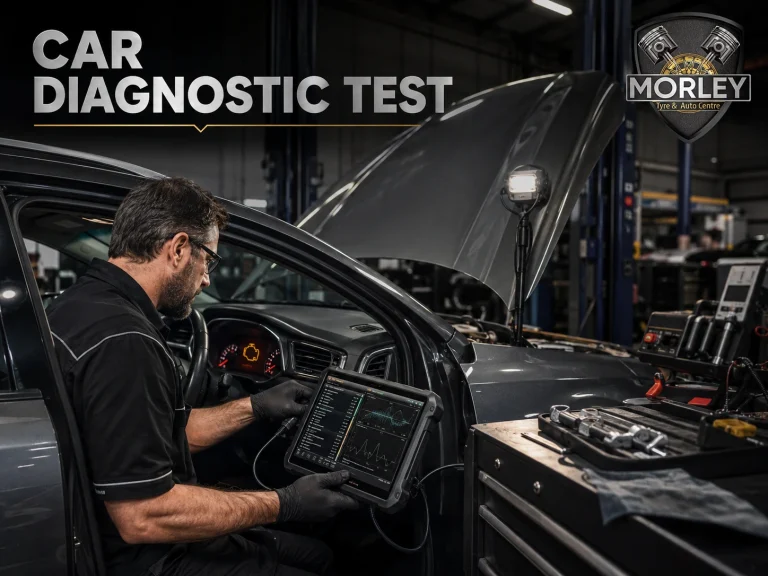
Modern vehicles are smarter than ever, but that also means diagnosing problems has become more complex. If your check engine light has come on or your car feels different to drive, you’ve come to the right place. A professional car diagnostic test helps identify hidden faults before they turn into costly repairs. This gives you a clearer understanding of your vehicle’s condition.
This guide will walk you through exactly what a car diagnostic test involves, what it checks, when you should book one, what it costs in Perth, and why a professional mechanic diagnosis is far more accurate than simply reading a fault code.
What Is a Car Diagnostic Test?
A diagnostic test is a computerised scan that reads the fault codes stored in your car’s onboard computer, showing which system triggered a warning light so a mechanic can confirm the cause.
It shows which system, such as the engine, transmission or brakes, has triggered a warning light or fault. The scan gives a starting point. Then, a qualified mechanic interprets the codes to confirm the actual cause.
Every car built from the late 1990s onward has an OBD (On-Board Diagnostics) port and a network of sensors constantly monitoring performance. When something falls outside its normal range, the vehicle logs a Diagnostics Trouble Code (DTC) and often triggers the check engine light. A diagnostic test retrieves that code and the data around it, turning what would otherwise be a mystery light into a specific, traceable fault.
Why Do Modern Cars Need Computerised Diagnostics?
Modern vehicles run on dozens of interconnected computer modules rather than purely mechanical parts, so a visual inspection alone can no longer catch most faults. Computerised diagnostic tools are needed to communicate directly with these systems and show what is actually happening inside them.
Your car’s Engine Control Unit (ECU) manages ignition timing, fuel delivery and emissions in real time. Whereas, separate modules handle the transmission, ABS brakes and airbags. These modules talk to each other over a shared network. A fault in one can throw off readings in another.
Advanced scanning equipment is the only reliable way to see inside this network, which is why guessing based on symptoms alone often leads to the wrong part being replaced.
How Does the Car Diagnostics Process Work? Step-by-Step Guide
The auto diagnostics process follows six steps, from connecting the scan tool through to confirming the fault before any repair goes ahead.
- Connect the scan tool. An OBD scan in Perth is usually the first step in diagnosing a modern vehicle. OBD (On-Board Diagnostics) is a standardised system fitted to virtually every passenger vehicle built over the past two decades, continuously monitoring the engine and other key systems. The technician plugs a scan tool into the OBD port, usually under the dashboard, to begin reading the vehicle’s data.
Professional workshops use manufacturer-level advanced scanning equipment, not basic consumer code readers, which reaches beyond the engine into modules such as ABS, airbags, automatic transmission, steering, climate control, body control and hybrid or EV systems where fitted. This lets a scan:
- Read stored fault codess
- Access pending fault codes
- Monitor live sensor data
- Check emissions-related systems
- Identify intermittent faults
- Verify repairs once work is complete
- Read the stored codes. The scanner pulls every Diagnostics Trouble Code the vehicle has logged, each one pointing to a specific system.
- Review live data. Beyond the codes, the mechanic checks live readings such as fuel trims, coolant temperature and oxygen sensor activity to see the fault as it happens.
- Carry out a physical inspection. Wiring, connectors, hoses and components linked to the fault code are checked by hand, since one code can have more than one possible cause.
- Road test if needed. Intermittent faults need a short test drive to reproduce. For example, an issue that only shows up under load or at speed.
- Confirm and quote. Once the root cause is confirmed, not just the code, you get a clear explanation and a quote before any repair work starts.
What Does a Car Diagnostic Test Check?
A car diagnostic test checks far more than just the engine. Modern vehicles contain multiple electronic control modules that monitor performance, safety, emissions, and comfort systems. A professional diagnostics test analyses these systems to identify faults, warning lights, and performance issues before they become major repairs.
The exact checks depend on your vehicle’s make, model, and the symptoms reported. A comprehensive diagnostic test usually covers the following systems:
Vehicle System | What the Diagnostic Test Checks |
Engine Management | Fuel injection, ignition timing, sensors, air-fuel mixture |
Transmission | Gear shifting, transmission sensors, fluid temperature |
ABS Braking System | Wheel speed sensors, ABS control module |
Airbags (SRS) | Airbag sensors and control modules |
Battery & Charging System | Battery voltage, alternator output, charging performance |
Cooling System | Engine coolant temperature sensors |
Emissions System | Oxygen sensors, catalytic converter, EVAP system |
Electronic Stability Control | Stability and traction control sensors |
Depending on the nature of the fault, technicians will also check the real-time data of sensors when the engine is in operation. This is important in detecting faults that can only be picked through real-time analysis.
What Are Diagnostics Trouble Codes (DTCs)?
A Diagnostics Trouble Code (DTC) is a standardised fault code stored by your vehicle whenever one of its electronic systems detects a problem. Each code points technicians towards the affected system, allowing them to begin an accurate diagnosis more efficiently.
The first letter tells you which system is affected, and the numbers that follow narrow it down further.
Prefix | System | Example |
P | Powertrain (engine, transmission) | P0300: random misfire detected |
B | Body (airbags, aircon, comfort systems) | B1000: general body module fault |
C | Chassis (brakes, steering, suspension) | C0035: wheel speed sensor fault |
U | Network and wiring (module communication) | U0100: lost communication with ECU |
As an example, P0420 usually points to reduced catalytic converter efficiency. P0171 flags a fuel system running too lean. A code identifies the affected system, not the exact part at fault. That is why fault diagnosis still needs a mechanic and not just the scanner.
Diagnostic Scan vs Complete Mechanic Diagnosis: What’s the Difference?
A diagnostic scan reads the fault codes your car has stored. A complete mechanic diagnosis goes further, using that code alongside live data and a physical inspection to confirm the actual root cause.
Diagnostic Scan | Complete Mechanic Diagnosis |
Reads stored fault codes | Interprets codes plus live sensor data |
Machine only | Machine plus a trained technician |
Identifies the affected system | Identifies the exact cause |
A starting point for repair | The basis for an accurate quote |
Available from basic code readers | Requires a qualified mechanic diagnosis |
A basic code reader can tell you a fault code exists. It cannot tell you whether a misfire is from a worn spark plug, a failed ignition coil or a vacuum leak. That distinction is exactly why a genuine mechanic diagnosis, not just a scan, stops you paying for parts you did not need.
Signs You Need a Car Diagnostic Test in Perth
A few common warning signs point to a fault worth scanning, even before the check engine light in Perth comes on.
- The check engine light is on, whether solid or flashing
- The engine idles roughly or hesitates when accelerating
- Fuel economy has dropped noticeably
- A warning light returns after a recent repair, which calls for an engine check light diagnostic to confirm the fix
- The car is hard to start or stalls unexpectedly
- The ABS or airbag light is on
- The transmission slips, hesitates or shifts roughly
- You notice unusual smells, smoke or noises with no obvious cause
What Can a Car Diagnostic Test Detect?
A professional diagnostic test can identify a wide range of issues before they become major mechanical failures. Some of the most common problems detected include:
- Engine misfires
- Fuel system faults
- Ignition system problems
- Faulty sensors
- Transmission faults
- ABS braking issues
- Airbag system faults
- Battery and charging problems
- Cooling system faults
- Emissions-related problems
- Electronic throttle faults
- Stability control issues
Many of these faults develop gradually. Detecting them early means simpler and more affordable repairs. Alos, it’s equally important to understand that diagnostic testing has limitations.
What Can’t a Diagnostic Scan Detect?
A diagnostic scan reads electronic and sensor-based faults, but it cannot detect purely mechanical wear, such as worn brake pads, cracked suspension bushes or uneven tyre wear.
Issues like these need a hands-on mechanical inspection or a broader vehicle inspection alongside the scan, not the scan tool on its own. This is one reason a diagnostic test and a general mechanical inspection are often booked together, particularly if your car is due for a service.
Car Diagnostic Test vs Pre-Purchase Inspection: What’s the Difference?
A car diagnostic test checks for stored fault codes on a vehicle you already own. A pre-purchase inspection is a broader mechanical and diagnostic check carried out before you buy a used car.
A pre-purchase inspection usually includes a full diagnostic scan as one part of a wider check covering brakes, suspension, tyres, fluid condition and signs of prior accident damage. If you are buying a second-hand vehicle in Perth, a diagnostic scan on its own will not catch everything a proper pre-purchase inspection would.
How Much Does a Car Diagnostic Test Cost in Perth?
In Perth, car diagnostic test cost anywhere between $80 and $180 for a standard scan, though the exact price depends on the type of test and your vehicle.
Service | Perth Price Range |
Basic code read (retail store or simple mobile call-out) | $30 – $80 |
Standard diagnostic scan | $80 – $180 |
Complex, specialist or dealership diagnostics (luxury and European vehicles) | $200 – $300+ |
A basic code read only tells you a fault exists, while a standard diagnostic scan adds live data analysis to narrow down the cause, and complex or specialist diagnostics on luxury and European vehicles cost more due to manufacturer-specific software and deeper system access.
How Long Does a Car Diagnostic Test Take?
Most car diagnostic tests take between 45 minutes and 90 minutes, covering the scan, live data review and a basic physical check.
A simple scan to retrieve fault codes is relatively quick. But, if additional testing is needed to confirm the cause, your mechanic may need extra time to inspect components, analyse live data, or perform a road test.
Here’s a general guide:
Service | Typical Time |
Basic diagnostic scan | 15–30 minutes |
Standard car diagnostic test | 30–60 minutes |
Complex fault diagnosis | 1–3 hours or longer |
Diagnostics with repairs | Varies depending on the repair required |
Remember, diagnosing the fault accurately the first time is more valuable than rushing the process and replacing parts unnecessarily.
What Are the Benefits of Car Diagnostics Tests?
Diagnostics of the car detect minor problems at a time when it is not difficult and expensive to fix them. The most significant advantages are:
- Cost savings: Problems are detected before they become costly repairs
- Ensures safety: Minor brake, steering and airbag problems are detected early
- Helps to maintain performance: Issues with gas consumption and engine power are fixed
- Favours resale value: Provides evidence of servicing and diagnostics carried out on the car
FAQs
Can I run a diagnostic test on my car?
Yes, you can run a basic diagnostic test on your own using a plug-in OBD-II scanner to read the error codes. But for comprehensive diagnostic scan, professional advice is required.
What are signs that my car needs a diagnostic?
Some common symptoms include illuminated check engine, ABS, or airbag warning lights, rough running, difficult starting, stalling, low fuel efficiency, and slipping transmission.
What does a full car diagnostic test consist of?
A complete car diagnostic test includes the use of a scan tool to read fault codes, review live data from sensors and physically inspect the system involved. It includes the major systems of a car like engine, transmission, braking, emissions and electrical systems.
Can a car diagnostic detect all problems?
No, a car diagnostic test is only able to detect faults related to the electronic systems and sensors of the car. It is capable of reading only the error codes and sensor data from the car’s computer.
How much does it cost to run a diagnostic check on a car?
A diagnostic check in Perth costs between $80 and $180 for a standard scan. Basic code reads can start from $30 to $80, while complex or specialist diagnostics on luxury and European vehicles can cost $200 to $300 or more.
Can a diagnostic test be wrong?
The scan itself is rarely wrong. Errors happen when a code is treated as the final answer instead of a starting point for further testing.
How accurate are diagnostic tests on cars?
Diagnostic scan tools are highly accurate at identifying which system has a fault, since they read data directly from the vehicle’s onboard computer. Pinpointing the exact cause still depends on the mechanic’s interpretation
Still driving around with that warning light on?
Ignoring a dashboard light does not make the fault disappear. It just gives it more time to turn into a bigger, more expensive repair.
Book Your Car Diagnostic Test at Morley Tyre Centre
Morley Tyre Centre has provided engine diagnostic service in Perth for local drivers across Morley, Noranda, Bayswater, Bedford, Bassendean and Pianella for over 10 years, using computerised diagnostic tools to get an accurate answer the first time.
Our team uses computerised diagnostic tools and advanced scanning equipment to find the real cause behind your warning light, not just the code.
Every diagnostic booking includes a full explanation of what the fault codes mean before any repair goes ahead, along with an upfront quote. If your diagnostic test points to a broader issue, our team also carries out full mechanical inspection and repair work in the same workshop, so you are not sent elsewhere for the fix.
View our full range of mechanical services.