Complete Preventive Fleet Maintenance Checklist for Perth Small Businesses
One unplanned breakdown can cost a small business more than three scheduled services combined. Lost hours, emergency repair bills, and a driver stuck on the side of the Tonkin Highway can quickly turn a productive day into an expensive one.
Preventive fleet maintenance is a structured approach that helps maintain fleet vehicles through scheduled inspections, servicing tasks, and safety checks. These checks keep your fleet roadworthy, compliant, and operating at full capacity.
Whether you’re having two tradie utes or a fleet of ten delivery vehicles, you can be sure to save money on maintenance costs, extend the vehicle’s longevity, and protect yourself from any surprise failures in your business.
In this blog, you’ll explore a handy fleet maintenance checklist involving daily checks, monthly activities, annual logbook considerations, tyre maintenance, and fleet scheduling tips. Let’s dig in.
What Is a Fleet Maintenance? Why Does It Matter for Perth Businesses?
Fleet maintenance is the planned inspection, servicing, and repair of business vehicles to keep them safe, compliant, and reliable.
A fleet maintenance program involves such tasks as daily vehicle inspection, tyre inspection, fluids check, brakes check, logbook servicing, wheel alignments, diagnostics, and planned maintenance. In Perth, fleet maintenance is important due to the severe summer temperatures, long distances driven, and harsh working conditions that can cause tyres wear, battery and mechanical failures quickly. Preventive fleet care will ensure that no such problems arise in the future.
Some of the fleet maintenance benefits include:
- Reducing vehicle downtime
- Lowering repair and operating costs
- Increasing driver and road safety
- Ensuring compliance and roadworthiness
- Saving the warranty of the vehicle
- Increasing the lifespan of the vehicle
- Improving fuel efficiency and fleet performance
Therefore, preventive maintenance is always more affordable than repairing. Now it’s time to move onto the actual list of checks for fleet maintenance.
Fleet Maintenance Checklist: Daily, Monthly, Annual Checks
A fleet maintenance checklist is a documented schedule of inspections, servicing tasks, and safety checks carried out across your vehicles at regular intervals. The following complete checklist breaks down the essential checks your business vehicles should undergo daily, monthly, and annually to stay safe, reliable, and roadworthy.
Daily and Pre-Trip Checks
Daily checks take less than five minutes but prevent the majority of on-road failures. Every driver should complete the following before leaving the depot or worksite.
- Tyre pressure and visual inspection: Check pressure against the vehicle’s placard (inside driver’s door), and inspect sidewalls and tread for cuts, bulges, or visible wear
- Engine oil level: Check the dipstick with the engine cold; top up with the correct grade if below the minimum mark
- Coolant level: Check the overflow reservoir is between MIN and MAX
- Lights: Test headlights, brake lights, indicators, reversing lights, and hazards
- Windscreen: Check for cracks, chips, and confirm wipers clear the screen without streaking; top up washer fluid
- Brakes: Apply the brakes firmly before pulling away; any sponginess, pulling to one side, or grinding sound needs immediate attention
- Dashboard warning lights: Any illuminated warning light (oil pressure, battery, engine, tyre pressure) must be investigated before the vehicle departs
Daily checks matter specifically in Perth, because Perth’s heat and dust create conditions that accelerate wear faster than most Australian cities. Tyre pressure fluctuates significantly with temperature change. Over-inflated tyres wear faster in the centre and are more vulnerable to blowouts on hot asphalt. This makes regular inspections essential for reducing uneven wear and blowout risks during summer.
Now, let’s move on to the monthly inspections to catch the issues that develop over weeks of regular use.
Monthly Fleet Vehicle Maintenance Checks
Monthly inspections should be completed by a qualified mechanic or a trained fleet manager. These tasks go beyond what drivers can check on the road and require a closer look at components that wear gradually over several weeks.
- Tyre rotation and balancing: Regular rotation of tyres between axles ensures even wear patterns and prolongs the tread life of the tyres.
- Brake pad wear: Brake pads less than 3mm thick require replacement; otherwise, rotor replacement will become inevitable, which could be much more expensive
- Air filter check: Clogged air filters decrease fuel efficiency; get them changed at every 15,000 – 20,000 km interval.
- Battery terminal condition: Ensure no corrosive deposits have formed on the terminals; Perth’s climate considerably reduces the battery’s life span.
- Fluid checks: The transmission oil, steering fluid, and brake fluid levels need checking and replenishment to appropriate levels if required.
- Suspension and steering: Check any abnormal bouncing or shaking of the car while driving; these are indications of worn-out shocks, struts, or ball joints.
- Undercarriage inspection: Check for any fluids dripping from the undercarriage area and any rusting of fuel, exhaust system components, and chassis parts.
The next level of fleet care comes at the annual service, and this is where logbook servicing makes all the difference.
Annual and Logbook Fleet Servicing in Perth
Annual logbook servicing is the most comprehensive level of fleet maintenance. Each vehicle manufacturer sets a specific service schedule; typically, every 10,000 to 15,000 kilometres or every 6 months, outlining exactly what must be inspected, adjusted, or replaced.
When a qualified mechanic completes these services and stamps the logbook, your factory warranty remains fully valid.
Annual logbook servicing for fleet vehicles should include:
- Engine diagnostics scan: To check for stored fault codes, even if no warning light is showing
- Brake rotor and calliper inspection: Rotors worn beyond minimum thickness must be replaced
- Timing belt or timing chain check: A snapped timing belt typically causes catastrophic engine damage; replacement at the manufacturer’s recommended interval is non-negotiable
- Wheel alignment: Particularly important for utes and vans carrying heavy loads, as misalignment causes rapid and uneven tyre wear
- Full safety inspection across lighting, steering, brakes, tyres, and structural components
- Oil and filter replacement with the correct grade for the specific engine
Once your annual servicing is in order, tyre health deserves its own dedicated attention, particularly in Perth’s conditions.
Fleet Tyre Maintenance Checklist for Perth Conditions
Tyres are the one component on your fleet vehicle that touches the road on every single trip, yet they are consistently under-maintained. In WA, the legal minimum tread depth is 1.5 mm, but many businesses should replace tyres earlier if grip, braking, or wear patterns start to drop off.
Tyre maintenance for Perth fleets should include the following:
- Correct tyre pressure for loaded and unloaded vehicles
- Regular tread depth checks
- Rotation before uneven wear gets severe
- Replacement when sidewalls are damaged or tread is close to limit
- The right tyre type for 4WDs, utes, vans, and loaded work vehicles
- Monthly pressure checks during hot weather
- Wheel alignment for load carrying vehicles
Hot weather can make underinflated tyres work harder, which is exactly why monthly pressure checks are worth the effort.
How to Set Up a Fleet Maintenance Schedule
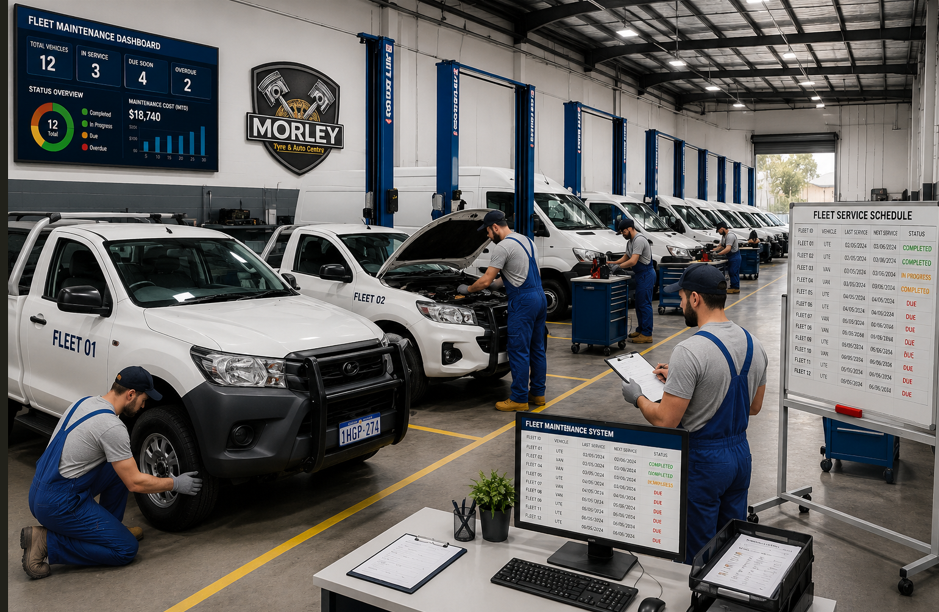
Having a checklist is one thing. Making it a repeatable system is what separates businesses that control their fleet costs from those that constantly react to them. Here is how to set one up from scratch.
- List down all your vehicles and their present reading on their odometers.
- Get the service interval for each of the vehicles. Some will need servicing every 10,000 km, while some will be every 15,000 km.
- Ensure that each driver is responsible for their respective daily vehicle check.
- Schedule both monthly and annual services well in advance.
- Create a service record for each vehicle and note the costs incurred for easy budget planning.
- Have your vehicles serviced by one trusted workshop for greater accountability and less chances of miscommunication.
Here is a quick reference table for scheduling your fleet maintenance across the year:
Frequency | Key Tasks |
Daily / Pre-Trip | Tyres, lights, oil, brakes, dashboard alerts |
Monthly | Brake pads, battery, filters, fluid levels, suspension |
Every 6 months / 10,000 km | Logbook service, diagnostics, wheel alignment |
Annually | Full safety inspection, timing belt, rotors, callipers |
Even with a solid schedule in place, there are warning signs that mean a vehicle needs attention right now, before the next scheduled service.
Signs a Fleet Vehicle Needs Immediate Attention
Do not wait for the next scheduled service if you notice any of these:
- Squealing brakes or knocking engine noises
- Dashboard warning lights
- Uneven tyre wear
- Pulling to one side
- Fluid leaks under the vehicle
- A battery that will not hold charge
These signs usually mean the issue is already developing. The faster you act, the less likely you are to face a breakdown or a larger repair bill.
Is your fleet one breakdown away from a missed job?
Keep Your Fleet Road-Ready with Morley Tyre Centre
Perth’s small business fleet owners trust us for scheduled logbook servicing, tyre management, brake inspections, and engine diagnostics; all with per-vehicle service records and priority bookings that work around your business.
Call (08) 9276 3488
FAQs
- How often should fleet vehicles be serviced in Australia?
Most light commercial vehicles need servicing after every 10,000 – 15,000km or six months; whichever occurs sooner. Always use the service intervals recommended by the logbook, as they are different for different manufacturers.
- What is included in a fleet maintenance checklist?
A comprehensive fleet maintenance checklist includes three stages:
- Pre-trip checks daily (tyres, oils, lighting systems, brakes, and warning indicators)
- Monthly checks (brakes, batteries, filters, engine fluids, suspension systems)
- Annual servicing (engines, wheel alignments, timing belts, and safety checks, and logbook stamp).
- Does fleet servicing void my vehicle warranty?
No. Car servicing will not invalidate your warranty, as long as it is serviced according to the manufacturer’s requirements and your log book is stamped by a certified mechanic every time you have your car serviced.
- How do I reduce fleet maintenance costs for my small business?
The best way to cut fleet maintenance costs is through preventive maintenance. This involves detecting and correcting small faults to prevent major faults which cost a lot more to fix.