
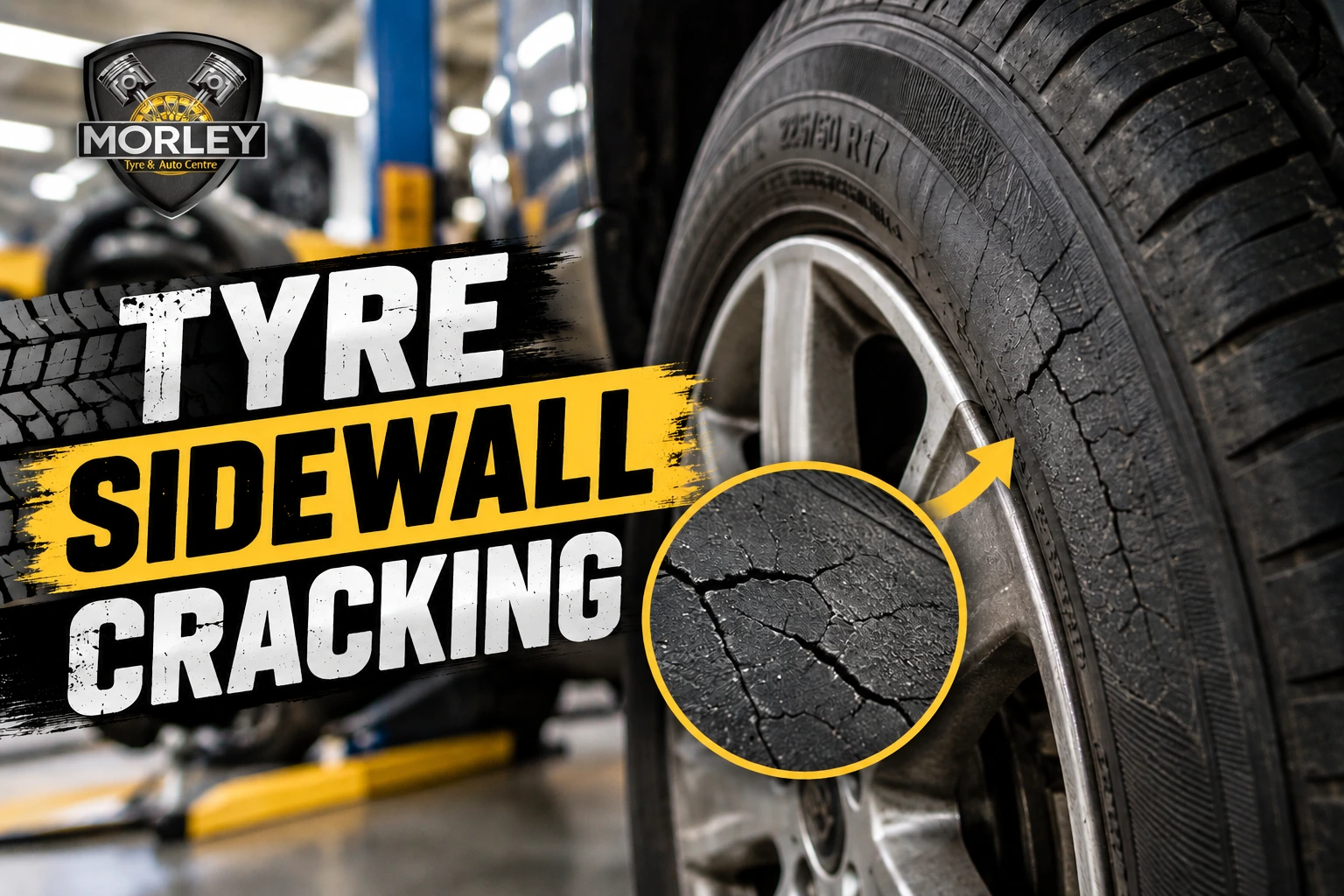
Tyre sidewall cracking can be a sign that the rubber is ageing or has been affected by its environment, but not every visible line means the tyre needs to be replaced immediately. The depth, location and pattern of the cracks matter.
Cracks around the bead, exposed cords, bulges or deep splits deserve prompt attention because the sidewall is a structural part of the tyre. Knowing what to look for can help you decide when a professional inspection is needed.
What Does Tyre Sidewall Cracking Look Like?
Tyre sidewall cracking usually appears as fine lines, small splits or a web-like pattern across the rubber, often becoming easier to notice as the tyre ages. The appearance can vary depending on how the rubber has deteriorated and where the damage has developed.
Some cracks are shallow and sit on the surface of the sidewall. Others can become deeper, wider or more concentrated around a particular area. A close inspection is useful because sidewall damage is not always obvious from a quick glance.
Look for:
- Fine hairline cracks spread across the sidewall
- Several cracks grouped together
- Longer splits that follow a horizontal, vertical or diagonal direction
- Cracks around the bead or rim area
- Rubber that looks dry, faded or weathered
- Bulges or changes in the normal shape of the sidewall
- Any visible cords beneath the rubber
It is also important to distinguish cracking from ordinary marks. A shallow scuff from contact with a kerb is different from a split that has penetrated deeper into the sidewall.
The inner sidewall deserves attention too. A tyre can have damage that is difficult to see while the wheel remains fitted to the vehicle, so an inspection should cover the tyre properly rather than relying only on the outside face.
What Causes Sidewall Cracking on Tyres?
Tyre sidewall cracking can develop as rubber ages, with sunlight, ozone, heat, storage conditions, tyre pressure and general exposure all potentially contributing to deterioration.
Tyres spend their working life exposed to air, road conditions and changes in temperature. Over time, the rubber can lose some of its flexibility. A vehicle that is driven frequently is not the only one affected; tyres on cars that spend long periods parked can also age.
Several factors can contribute to cracking:
Ageing rubber
Tyres gradually change as they get older. The tread may still appear usable while the rubber in other areas has started to deteriorate.
This is one reason tread depth alone should not be used to judge tyre condition.
Sunlight and weather exposure
UV exposure can contribute to rubber deterioration, particularly when a vehicle spends long periods outside. Perth’s strong sunlight makes regular visual checks sensible, although cracking can occur in other climates as well.
Incorrect tyre pressure
Incorrect inflation changes how the tyre flexes while driving. Consistently running at an unsuitable pressure can contribute to abnormal stress and uneven wear.
Long periods without use
A car that rarely moves is not automatically protected from tyre ageing. Time, storage conditions and environmental exposure continue to affect the rubber even when the vehicle is parked.
Damage around the rim
Kerb contact, mounting damage or impact near the wheel can affect the area around the bead. Cracking close to the rim therefore deserves particular attention rather than being treated as ordinary surface weathering.
When Are Cracks in a Tyre Sidewall Unsafe?
Cracks in a tyre sidewall become more concerning when they are deep, spreading, associated with deformation or accompanied by signs that the tyre’s structure has been compromised.
There is no reliable universal measurement where a crack below a certain number of millimetres is automatically safe and anything above it automatically requires replacement. A proper assessment considers the location, depth, condition of the surrounding rubber, tyre age and any other visible damage.
A tyre needs closer inspection when you notice:
- Deep or open cracks
- Cracks that are widening or spreading
- A bulge or bubble near the cracked area
- Visible cords or internal material
- Damage around the bead or rim
- A significant cut rather than a surface line
- Multiple forms of sidewall damage on the same tyre
- Unusual vibration, handling changes or loss of pressure
WA regulations require tyres fitted to vehicles to be free from an apparent defect that could make the vehicle unsafe. Transport WA also advises motorists to check tyre tread, pressure and the tyre body for damage as part of regular vehicle maintenance.
That means the question is not simply, “How many cracks are there?” The more important question is whether the damage affects the tyre’s condition and safe use.
Tyre Sidewall Cracking Chart: What Does the Damage Mean?
A simple tyre sidewall cracking chart can help you understand what you are seeing, but it should be used as a guide rather than a replacement for an inspection.
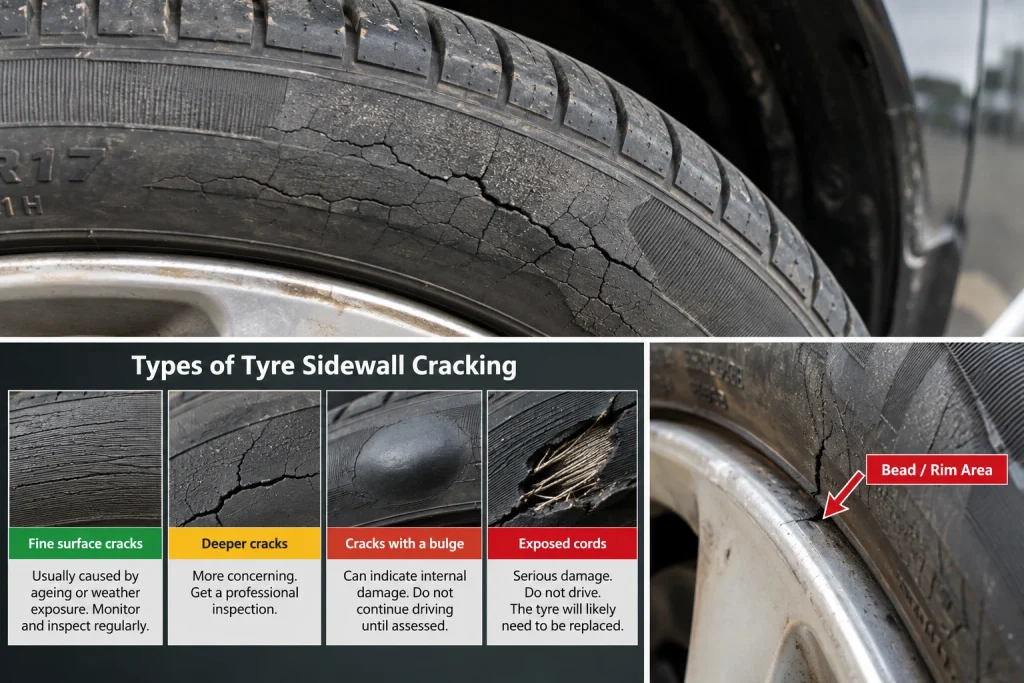
What you see | What it may indicate | What to do |
Fine, shallow hairline lines | Early surface deterioration | Monitor closely and have the tyre checked |
Several cracks grouped together | More noticeable rubber deterioration | Arrange a professional inspection |
Deep or open splits | Potential structural damage | Avoid unnecessary driving and seek an assessment |
Cracking with a bulge | Possible internal structural problem | Do not continue driving until assessed |
Cracks near the rim or bead | Possible damage around the tyre mounting area | Have the tyre inspected promptly |
Visible cords | Significant damage to the tyre structure | Do not drive on the tyre; replacement may be required |
Cracking plus repeated pressure loss | Possible tyre damage or another fault | Have the tyre and wheel checked |
The chart does not provide a fixed replacement rule because two tyres with similar-looking cracks can have different underlying conditions.
A tyre professional can assess the damage from different angles and determine whether the tyre remains suitable for road use.
Is It Safe to Drive With a Cracked Sidewall?
Driving with a cracked sidewall should not be treated as automatically safe, particularly when the cracks are deep, accompanied by a bulge, located near the bead or associated with pressure loss.
If you notice minor surface lines with no other symptoms, arrange an inspection rather than assuming the tyre has failed. If you can see exposed cords, a significant split, a bulge or a rapidly worsening defect, avoid driving the vehicle until the tyre has been assessed.
A tyre that is losing pressure should also not be driven simply because it still has plenty of tread. Pressure problems can change how the tyre flexes and can create additional stress.
Transport WA recommends checking tyres regularly for correct pressure, adequate tread and damage to the tyre body.
If you are unsure whether the tyre can safely reach a workshop, getting professional advice before driving is the safer approach.
What Does Tyre Sidewall Cracking Near the Rim Mean?
Tyre sidewall cracking near the rim can be more concerning because the area around the bead plays an important role in keeping the tyre securely seated on the wheel.
A crack in this location should not automatically be dismissed as ordinary ageing. It may be related to age, environmental deterioration, mounting damage, an impact or another issue affecting the tyre.
Check for other signs at the same time, including:
- Cuts or tears
- Distortion around the bead
- Rubber separating from the rim area
- Loss of air pressure
- Previous kerb or pothole impact
- Damage that extends into the sidewall
Because this area is difficult to assess properly while the wheel remains on the car, professional inspection is worthwhile if the cracking appears significant.
Can Sidewall Cracking Be Repaired?
Sidewall cracking is generally not treated in the same way as a suitable tread puncture, because the sidewall flexes considerably and contributes to the tyre’s structural performance.
This is different from a small puncture in an appropriate area of the tread. A sidewall split, deep crack or structural defect may require tyre replacement rather than a repair.
It is also worth being careful with products marketed as a way to restore cracked tyre rubber. These may change the appearance of the sidewall without addressing underlying structural deterioration.
If you are unsure whether a tyre has a repairable puncture or sidewall damage, the safest approach is to have the tyre assessed rather than attempting a DIY repair.
For related information about when a tyre problem may be repairable, you can refer to Morley Tyre Centre’s car tyre puncture repair guide before deciding what to do.
When Should You Replace Tyres With Sidewall Cracks?
Tyres with significant sidewall cracks should be replaced when inspection shows that the damage compromises the tyre or makes it unsuitable for safe road use.
Replacement may be appropriate when there are deep splits, exposed cords, bulges, substantial deformation or serious deterioration around the sidewall or bead.
Age should also be considered alongside condition. A tyre can have acceptable tread while the rest of the rubber has deteriorated. Conversely, a tyre with a small surface mark does not necessarily need immediate replacement simply because a crack is visible.
This is why replacement decisions should consider the complete condition of the tyre rather than relying on one visual feature.
If your tyres are approaching the end of their usable life, understanding how many kilometres tyres last can also provide useful context. Actual tyre life varies according to the vehicle, driving conditions, tyre type, maintenance and wear.
How Can You Prevent Tyre Sidewall Cracking?
Regular tyre checks, correct inflation and sensible storage can help you identify and manage tyre deterioration before it becomes a larger problem.
Start with the basics:
Check tyre pressure regularly
Use the vehicle manufacturer’s recommended pressure and check it when the tyres are cold. Incorrect pressure can affect handling, wear and tyre stress.
Inspect the sidewalls
Look around the entire visible sidewall rather than checking only the tread. Look for cracking, cuts, bulges, scuffs and changes in shape.
Check tyres after impacts
A hard kerb strike or pothole impact can cause damage that is not immediately obvious. If the tyre looks different afterwards or begins losing pressure, have it checked.
Avoid relying on tread alone
Good tread depth does not automatically mean the whole tyre is in good condition. Transport WA recommends checking tread depth, pressure and tyre body damage as part of routine vehicle maintenance.
Pay attention to tyres on parked vehicles
A vehicle that spends weeks or months sitting unused still needs tyre inspections. Look at the sidewalls before returning the vehicle to regular driving.
For drivers comparing replacement options, Morley Tyre Centre’s range of car tyres provides a useful starting point when a worn or damaged tyre needs to be assessed.
What Should You Check When Replacing a Damaged Tyre?
When replacing a tyre affected by sidewall cracking, check more than the size printed on the existing tyre.
The replacement needs to be suitable for the vehicle and matched to the required specifications, including the correct size, load capacity and speed rating. The vehicle’s tyre placard provides important information about approved tyre specifications.
It is also worth checking the other tyres on the same vehicle. If one tyre is showing noticeable ageing while the others are in better condition, an inspection can help determine whether the problem is isolated or part of broader tyre ageing.
WA’s vehicle safety information also highlights the importance of correct tyre specifications, pressure and tyre condition.
Do not choose a replacement solely because it has the same tread pattern or looks similar. The tyre must be appropriate for the vehicle and its intended use.
Have You Spotted Cracks on Your Tyres? Talk to Morley Tyre Centre
Morley Tyre Centre can help drivers assess concerns about tyre condition before deciding whether a tyre should remain in use or be replaced. The workshop is located at 281 Walter Rd W, Morley WA 6062, serving drivers in Morley and surrounding Perth suburbs.
If you have noticed sidewall cracking, unusual wear, pressure loss or other visible tyre damage, contact the team for advice about the next step.
Morley Tyre Centre is open Monday to Friday, 8 am–5 pm, and Saturday, 8 am–12 pm. You can also contact Morley Tyre Centre to make an enquiry.
FAQs
Can tyre sidewall cracking happen when the car is rarely driven?
Yes, lack of driving does not stop tyres from ageing. Environmental exposure, storage conditions and the passage of time can still affect the rubber, so parked vehicles should also have their tyres inspected periodically.
Why is only one tyre showing cracks?
One tyre may have experienced different exposure, an impact, mounting damage, pressure issues or a different usage history from the others. A single damaged tyre should therefore be assessed on its own rather than assuming all four tyres have the same condition.
Should I inspect the inside of the tyre sidewall?
Yes, when possible. Damage is not always visible from the outside, particularly when the tyre remains mounted on the vehicle. A professional inspection can provide a more complete view of the tyre’s condition.
Does having plenty of tread mean a cracked tyre is safe?
No the tread depth is only one part of tyre condition. A tyre can have usable tread while also showing sidewall deterioration or other damage, which is why the entire tyre should be inspected.