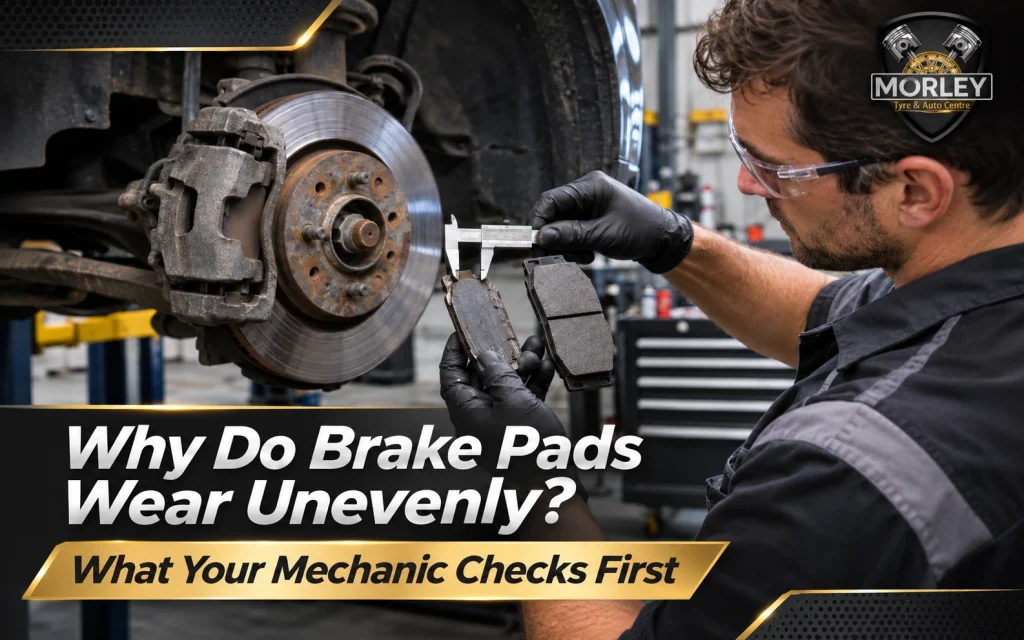
You pick the car up after a service, and the mechanic mentions something odd. The front-left pads are nearly down to the backing plate, but the right side still has plenty left. It’s a common moment for drivers across Morley, Dianella, Noranda, Bayswater, Bedford and Bassendean, and it raises a fair question: why do brake pads wear unevenly?
In most cases, uneven wear isn’t the problem itself. It’s a clue that another part of the brake system may not be doing its job.
If you are wondering how long brake pads last in normal driving, read our guide first.
Why do brake pads wear unevenly?
Brake pads wear unevenly when something stops them from pressing on the rotor and releasing evenly. Common causes include a sticking caliper, seized slide pins, a worn or uneven rotor, or a fitting problem. One pad, or one part of a pad, then does more work and wears faster than the rest.
Left alone, uneven wear can make braking less balanced, damage the rotors (discs), and shorten the life of replacement pads.
Uneven brake pad wear patterns and what they usually mean
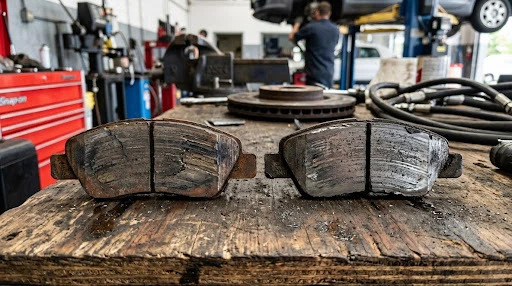
The way old pads have worn can tell a mechanic a lot. Even wear across all pads usually means the hardware has worked properly. Odd shapes or big differences often point to a specific part.
| Pattern | What it looks like | Common causes |
| Inner pad thinner than outer | The pad nearest the piston has much less friction material | Caliper not sliding or retracting smoothly: seized slide pins, a corroded piston, cracked seals or dust boots |
| Outer pad thinner than inner | The outside pad is worn more | Outer pad staying against the rotor after the caliper releases; less often, a master cylinder fault |
| Tapered | Wedge-shaped, thinner at one end or edge | Uneven force across the pad: fitting issues, corroded abutment clips, worn guide pins or bushings |
| One wheel worse than the other side | e.g. front-left nearly gone, front-right fine | A dragging brake on that wheel |
| Glazed or cracked | Shiny, hard surface, cracks or lifted edges | Overheating |
A wear pattern is a starting point, not a diagnosis. The cause still needs to be confirmed on the car.
What causes uneven brake pad wear?
Uneven wear often comes from parts that should move freely but don’t. Slide pins, caliper pistons and the pads themselves all shift slightly each time you brake. When rust, grime or perished rubber gets in the way, a pad can drag or press unevenly. Rotor faults, hose problems, fitting issues and heat are other common causes.
Seized or dry slide pins (guide pins)
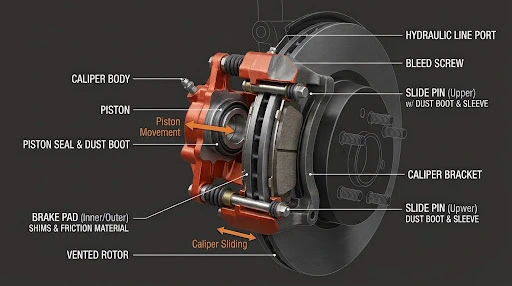
Many everyday cars use a floating (sliding) caliper. It moves on two pins so it can clamp both pads with equal force. If those pins dry out or corrode, the caliper may not centre itself, and one pad carries more of the load.
Sticking caliper piston
The piston pushes the inner pad onto the rotor, then eases back a fraction when you lift off the pedal. A worn piston seal, corrosion or a torn dust boot can stop that return, so the pad keeps rubbing between stops.
Pads stuck in the caliper bracket
Pads ride in a bracket on thin metal abutment clips (shims). Rust can build up underneath and stop a pad from releasing cleanly.
Rotor problems
Disc thickness variation (DTV) means the rotor is slightly thicker in some spots. The pads meet those high spots harder on every rotation, which can wear them patchily and cause a pulse through the pedal.
Restricted or collapsed brake hose
The rubber brake hose to each wheel can deteriorate inside with age. In some cases it lets pressure reach the caliper but releases it slowly, so that brake stays partly applied.
Fitting problems
Pads that aren’t seated properly, reused worn hardware, or clips installed the wrong way round can all lead to uneven contact. On single-piston calipers, the leading edge of the pad can also bite harder.
Heat
Hard stops in Walter Road traffic, long descents through the Perth Hills, towing a boat or caravan, and resting a foot on the pedal all build heat. Excess heat can glaze or crack the friction material.
Why is one brake pad thinner than the other?
On a sliding caliper, the inner and outer pads on the same wheel should wear at a similar rate. When one is much thinner, a common reason is that the caliper isn’t sliding or retracting properly. One pad then stays in contact with the rotor longer than its partner each time you brake.
A small difference is normal. The piston pushes the inner pad first, so it often ends up slightly thinner, typically by a millimetre or two over the life of the pads. A much bigger gap is a good reason to have the caliper inspected.
Brake pads wearing on one side only
When one wheel’s pads, say the front left, wear much faster than the other side, that brake may be dragging. A sticking caliper, seized slide pins or a restricted brake hose on that wheel can keep the pads lightly applied as you drive, wearing them down and building heat.
On cars where the handbrake (park brake) works through the rear calipers, a sticking park brake mechanism can affect one rear wheel in a similar way.
How to tell if a caliper is sticking
- One wheel feels noticeably warmer than the others after a drive
- A hot, burning smell when you park
- Much more brake dust on one wheel than its partner across the axle
- A slight pull even when you’re not braking
Signs your brake pads are wearing unevenly
Uneven wear is hard to see without removing the wheels. These clues often show up first:
- Pulling under braking: one brake may be gripping harder than the other.
- Squealing: many pads have a small metal wear indicator that squeals when the pad gets low.
- Grinding: often metal-on-metal contact, which can damage the rotor.
- Vibration or pulsing: felt through the pedal or steering wheel.
- A soft or spongy pedal, or weaker stopping: the brakes feel different from how they used to.
What your mechanic checks first
A thorough brake inspection looks at the whole system, not just the pads. It typically covers:
- A test drive: feeling for pulling or vibration, and listening for squeals, grinding or knocks.
- Pad measurements on every wheel: comparing inner with outer, left with right, and front with rear, then reading the wear pattern.
- Caliper movement: whether the caliper slides on its pins, the piston returns, and the seals and dust boots are intact.
- Pad movement in the bracket: whether the pads move freely, and the condition of the clips and shims.
- Rotor condition: thickness and run-out (wobble) against the manufacturer’s specification, plus any scoring or hot spots.
- Hoses and fluid: signs of perished or swollen hoses, and brake fluid level and condition.
- Related parts: wheel bearings, suspension, steering and tyres can all affect how a car feels under braking.
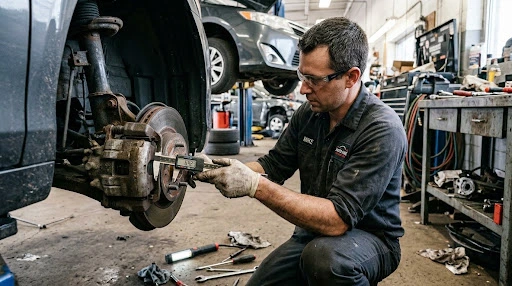
At our family-owned Morley workshop, we inspect your vehicle first and give you a clear, itemised quote before any work begins. If we find anything extra, we call you to talk through the options before going ahead. Brakes are also part of our wider car maintenance checklist, which helps catch problems like this early.
Why new brake pads alone won’t fix uneven wear
Fitting fresh pads to a caliper that still sticks only resets the clock. The same wear pattern is likely to return, and the rotors can suffer along the way.
A lasting repair deals with the cause first. Depending on what’s found, that may involve the caliper and its slide pins, the rotors, or a brake hose. New pads then go on in axle pairs, both fronts or both rears, to help keep braking balanced. Our brake repairs cover checking, repairing or replacing pads, rotors, calipers and brake fluid.
FAQs
Is it normal for front brake pads to wear faster than the rear?
On many cars, yes. Weight shifts forward when you brake, so the front brakes usually do more of the stopping. Some newer models use electronic brake-force distribution (EBD) to give the rear brakes more work, so rear pads on those cars can wear at a similar or faster rate.
Is it safe to drive with unevenly worn brake pads?
Get it checked soon rather than waiting for your next service. In WA, a vehicle found to be unroadworthy can be issued a defect notice (yellow sticker), and it is then inspected for all defects, not only the one listed.
Do I need new rotors if my pads wore unevenly?
Not necessarily. Manufacturers specify a minimum thickness for rotors. If a rotor is within that limit and free of deep scoring or cracks, it may not need replacing. If it isn’t, replacement is usually recommended.
Can a wheel alignment cause uneven brake pad wear?
Uneven pad wear is usually traced to the brakes themselves: the calipers, slide pins, rotors or hoses. Alignment and suspension problems can still change how the car behaves under braking. Our wheel alignment page explains what misalignment can affect.
Could a recall be behind my brake problem?
It’s possible. Manufacturers have issued recalls for brake faults, including brake hoses and calipers on some models. You can search your make and model on the Australian Government’s vehicle recalls site. Recall repairs are arranged through the manufacturer or supplier running the recall.
Book a brake inspection in Morley
Noticed a pull, a burning smell, or one pad thinner than the other? Have it checked early, before it costs you a set of rotors.
Our qualified mechanics on Walter Road, Morley, check the whole brake system with no hidden costs. Need tyres or a wheel alignment too? We can do your brakes and tyres in the same visit, so it’s one drop-off and one pick-up. We’re open Saturdays as well.
Book your brake inspection online or call (08) 9276 3488. You can also see everything we offer on our mechanical services page.
Disclaimer: This article is general information only and isn’t a diagnosis for any particular vehicle. Some causes, checks and repairs described here, such as rotor machining, wheel bearing work, brake hose replacement and recall repairs, are included to explain how brakes work and aren’t necessarily services offered by Morley Tyre & Auto Centre. For advice about your car, contact us or a qualified mechanic.