Essential Guide to Wheel Alignment: Types, Process, & Solutions Explained
Perth roads are not easy on your car’s wheels. Between the speed humps along Walter Road, the long flat stretches of Tonkin Highway, and the occasional pothole that appears after winter rains, your car’s suspension takes a beating. At Morley Tyre Centre, we have been working on vehicle geometry for Perth drivers for over 10 years. This guide covers what the service actually involves, how to tell when your car needs it, what happens on the day, and which type your vehicle requires.
What Is Wheel Alignment?
Wheel alignment means adjusting the angles of your vehicle’s wheels so they match the manufacturer’s specifications. When the angles are correct, your tyres sit perpendicular to the road and parallel to each other. This affects how your car steers, how evenly your tyres wear, and how efficiently your engine uses fuel.
Three angles matter. Each one affects your driving in a different way.
Camber
Camber is the inward or outward tilt of the wheel when you look at the car from the front. A slight negative camber (tilting inward at the top) is normal and actually helps with cornering. Too much tilt either way wears out the edge of your tyre much faster than the centre.
Toe
Toe measures whether your wheels point slightly inward or outward when viewed from above. Think of your feet: toes pointing in versus toes pointing out. Toe is the most important angle for tyre wear. Even a small deviation causes rapid scrubbing of the tread surface, especially at highway speeds.
Caster
Caster is the angle of the steering pivot when viewed from the side of the car. Positive caster helps your car drive straight and gives you stable steering at speed. Most modern cars run positive caster. If caster is off, your car may pull to one side or your steering may feel vague.
Signs Your Car Needs a Check
Not sure if this is your problem? These are the most common signs Perth drivers report before coming in:
- Pulling to one side: your car drifts left or right when you drive straight on a flat road
- Off-centre steering wheel: the wheel sits at an angle even though you are driving straight
- Uneven tyre wear: the inner or outer edge of one tyre is wearing faster than the rest
- Steering vibration: you feel vibration through the steering wheel, especially at higher speeds
- Unstable freeway driving: your car wanders or does not track straight on the freeway
Quick test: find a flat, empty carpark. Drive slowly in a straight line and let go of the steering wheel briefly. If the car drifts left or right, the angles are likely off. If the steering wheel shakes but the car tracks straight, it may be a balancing issue instead. Read our guide on the difference between wheel alignment and balancing.
Types of Wheel Alignment
There are three main types. Which one your vehicle needs depends on its suspension design and what you are experiencing.
1. Front-End Alignment
This adjusts only the front wheels. It suits older vehicles with a solid rear axle where the rear wheels sit in a fixed position. The mechanic corrects the toe, camber, and caster angles at the front to bring them back to manufacturer specs.
When you need it: front tyres wearing unevenly, car pulling to one side, steering that feels off after hitting a kerb.
2. Four-Wheel Alignment
Most modern cars, SUVs, and 4WDs require this service. All four wheels are measured and adjusted. The rear wheels are set first, then the front wheels are corrected to match. This is the most thorough option and the one most Perth vehicles need.
When you need it: rear tyres wearing unevenly, car feels unstable in corners, after suspension repairs or new tyres fitted.
3. Thrust Alignment
This makes sure the rear wheels are perfectly squared with the vehicle’s centreline, then the front wheels are set to match. It is used on solid rear axle vehicles where the axle position may have shifted. If your car feels like it is moving diagonally, sometimes called dog-tracking, this is likely what you need.
When you need it: car feels like it is crabbing or moving sideways, after rear axle repairs or rear-end collision damage.
Type | Best For | What Gets Adjusted |
|---|---|---|
Front-End | Older vehicles, solid rear axle | Front wheels only |
Four-Wheel | Modern cars, SUVs, 4WDs | All four wheels |
Thrust | Solid rear axle, dog-tracking issues | Rear axle squared, then front matched |
How Perth Roads Affect Your Vehicle’s Geometry
Perth has specific road conditions that make this a more regular concern than in other Australian cities.
- Speed humps: they are everywhere in Morley, Beechboro, Bayswater, and Bassendean. Each one applies a small force to your suspension. Over time this shifts the angles, particularly camber.
- Summer heat: Perth summers are long and hot. Heat causes tyre pressure to rise, and overinflated tyres wear differently. Combined with angles that are off, this accelerates uneven wear significantly.
- Long straight roads: Wanneroo Road, Tonkin Highway, and Reid Highway are driven at sustained speed. Even a small toe error causes measurable tyre scrub over these distances.
- Carpark kerbing: a common cause of sudden angle shifts across Morley and surrounding suburbs, particularly affecting caster.
Most local mechanics recommend a check every 10,000 km. If you regularly drive on rough suburban roads or speed humps, every 8,000 km is reasonable.
What Happens at Morley Tyre Centre
The process is straightforward and usually takes 30 to 60 minutes depending on your vehicle.
Step 1: Initial Inspection
Before any adjustments, the technician checks your suspension components — ball joints, tie rods, and bushings. There is no point correcting angles on worn parts because they will shift again the moment you drive out. If anything is worn, we tell you before starting work.
Step 2: Measuring the Angles
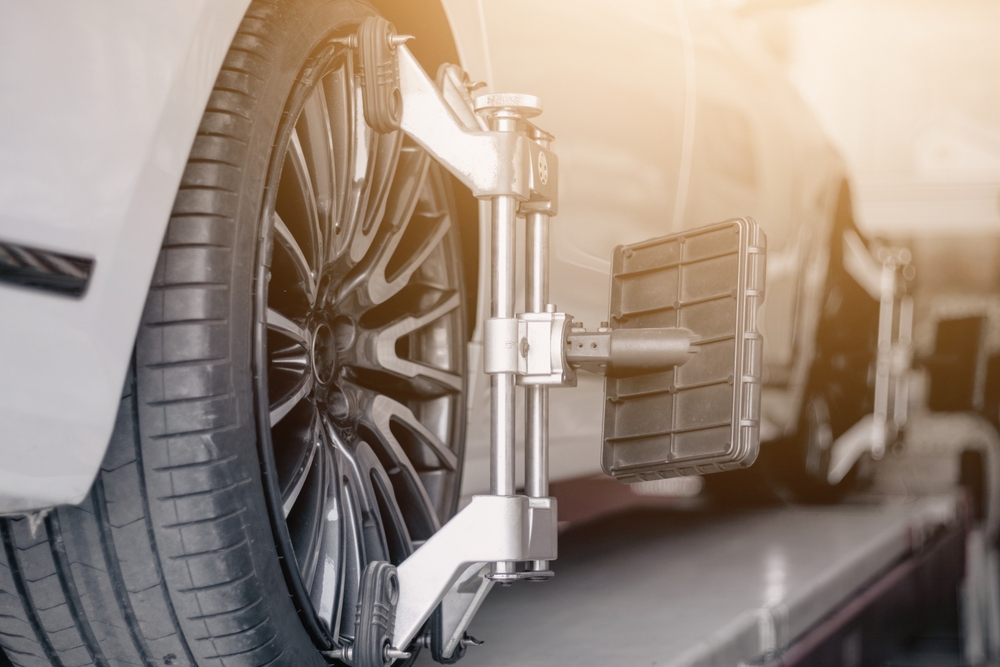
Your car is placed on the rack and sensors are attached to each wheel. The computerised system measures the current camber, toe, and caster precisely and compares them against your vehicle manufacturer’s specifications. The results show in real time, displaying exactly how far each angle is outside the acceptable range.
Step 3: Making the Adjustments
The technician corrects each angle within the suspension system, not the wheels themselves. Toe is adjusted via the tie rods. Camber is corrected through the suspension mounts. Caster is adjusted by repositioning the control arms. After all adjustments are made, the car is remeasured to confirm everything is within spec. You receive a printed report showing before and after readings.
Ask for your report after every visit. It shows exact angles before and after, and helps you spot patterns over time. If camber consistently shifts on one side, it may point to a suspension component that needs attention.
How to Read Your Alignment Report
The report shows three measurements for each wheel. Here is what the numbers mean:
Angle | Typical Range | What It Affects |
|---|---|---|
Camber | -1 to +1 degree | Edge tyre wear, cornering stability |
Toe | 0 to +0.15 degree | Straight-line tracking, centre tread wear |
Caster | +2 to +6 degrees | Steering feel, straight-line stability |
Green zones mean the angle is within spec. Red zones mean adjustment was needed. If your report shows red zones that were not corrected because of worn suspension parts, sort those parts before your next check.
When to Book a Check
- Every 10,000 km as part of regular maintenance
- When you fit new tyres
- After hitting a significant pothole or kerb
- After any suspension or steering repairs
- If you notice any of the signs listed above
- After a minor collision, even a low-speed one
About Morley Tyre Centre
We have been serving Perth’s northern suburbs for over 10 years. Our computerised equipment measures all four wheels simultaneously and produces a printed report for every job. Our technicians work on all makes and models including passenger cars, SUVs, 4WDs, and light commercial vehicles.
Located at 281 Walter Rd W, Morley WA 6062. Open Monday to Friday 8AM to 5PM and Saturday 8AM to 12PM.
Ready to get your wheels checked? Book your appointment at Morley Tyre Centre most jobs done within the hour.
Frequently Asked Questions
The clearest signs are: your car pulls to one side on a flat road, the steering wheel sits off-centre when driving straight, or you notice uneven tyre wear on the inner or outer edges. You can also do a quick test in a flat, empty carpark by briefly releasing the steering wheel at low speed. If the car drifts, a check is likely needed.
Every 10,000 km is the standard recommendation, or at least once a year. Perth drivers who regularly navigate speed humps or rough suburban roads may benefit from checking every 8,000 km. Always book a check after fitting new tyres or after any suspension work.
These are two different services. Alignment adjusts the angles of the wheels relative to each other and the road. Balancing corrects the weight distribution within the tyre and wheel assembly. Misalignment causes pulling and uneven tyre wear. Imbalance causes vibration, usually felt through the steering wheel at higher speeds. Read our full guide on the difference between wheel alignment and balancing.
At Morley Tyre Centre, a standard check and adjustment takes 30 to 60 minutes. Four-wheel jobs on vehicles with more complex suspension may take slightly longer. If worn suspension parts are found during the inspection, we will advise you before starting any additional work.
Not accurately. The process requires computerised equipment that measures angles to fractions of a degree. Attempting adjustments without this risks making the problem worse. Some workshops sell DIY toe gauges for basic front-end toe checks, but these cannot measure camber or caster and are not a substitute for a professional service.
Yes. Wheels that are out of spec create rolling resistance because the tyres fight against the road surface rather than rolling cleanly. This forces the engine to work harder. Correcting the angles reduces drag and can improve fuel efficiency by a measurable amount, particularly on long highway drives.
Performance cars with sensitive suspension setups, off-road 4WDs that regularly drive on rough terrain, vehicles modified with lowered or lifted suspension, and commercial vehicles carrying heavy loads all benefit from more frequent checks. For these vehicles, every 8,000 km is a reasonable interval.
Yes, it is worth checking. A significant impact from a pothole or kerb can shift your angles, particularly the caster. Even if the car feels fine immediately after, subtle changes cause gradual tyre wear and fuel efficiency loss. A quick check after a hard impact is inexpensive and gives you peace of mind.